At riksgalden.se, we use cookies to improve your experience on our website and to collect statistics. We also use cookies for analyzing to improve our website. More about cookies.

Risk management
Risk management is essential for the Debt Office. The costs of managing the central government debt, administering the central government payment systems and the pricing of guarantees and loans depend, among other factors, on the ability to assess and manage risks.
In addition, risks continually arise within the operations due to the Debt Office’s own actions and decisions. The aim of risk management is for the Debt Office to have good internal management and control through effective and appropriate risk management in accordance with market practice.
The Debt Office’s risk management process
The purpose of the risk management is to identify and manage risks that may
affect the execution of the Debt Office’s assignments or have an adverse effect
on the Debt Office’s finances, reputation, or operations. The risk management
process is to ensure a systematic working method and encompass risk
identification, evaluation, measures and priorities, implementation, and follow
up and reporting.
We work systematically with risk management in five steps:
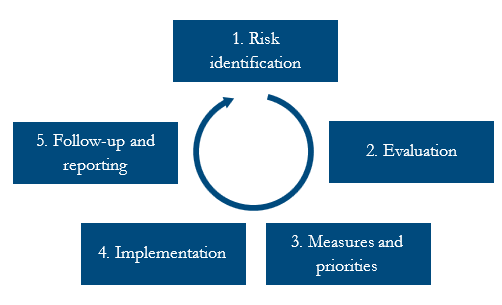
Risk identification: The Debt Office is to have processes and methods for identifying risks in the operations.
Evaluation: The method for evaluating identified risks may vary among different types of risk. For certain risks, the evaluation is done considering likelihood and consequence, and for other risks quantitative methods and models are used.
Measures and priorities: After identification and evaluation, the management of the risk is decided on. The risk owner can choose between eliminating, limiting, transferring (insuring), or accepting the risk without measures being taken. The choice depends on the evaluation of the risk and which risk appetite or risk level is decided on by the Board. A trade-off is to be made between expected cost and risk. Implementation: Measures decided on are carried out by the area of operation.
Follow-up and reporting: The effects of the risk management are monitored, evaluated, and reported in accordance with the procedures decided on by the agency.
Financial and Non-financial Risks
The risk map is intended to provide an overarching picture of the main risks associated with the Debt Office’s operations. The risks are defined in Appendix 1 – Definitions.
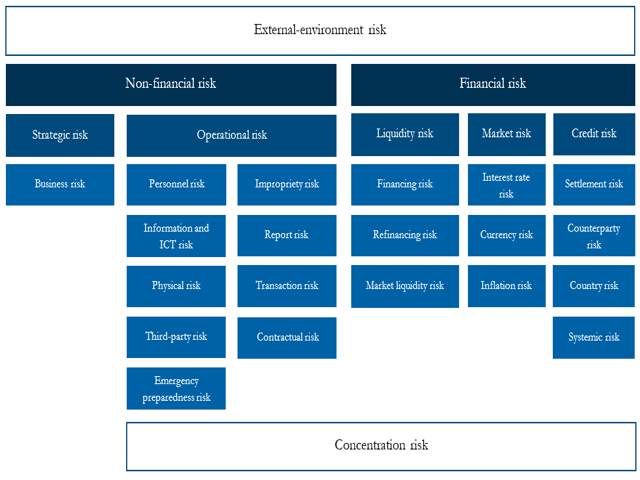
Risk Map
Responsibilities at several levels
The Board of the Swedish National Debt Office is responsible for ensuring that there is a process in place that guarantees sound internal governance and control within the agency. The Board adopts annually a financial policy, a risk policy, and a policy for internal governance and control, and receives regular reports on current risk levels
The Director General is accountable to the Board and is responsible for leading and managing the agency’s day‑to‑day operations in accordance with the directives issued by the Board.
The responsibility for internal governance and control within the organization is divided according to the principle of the three lines of responsibility. These lines clarify who is responsible for internal governance and control, including risk management, within the operations.